Where to Put a Laundry Basket So It Fits the Room
Where to put a laundry basket depends on how clothes move through your home. Choose a spot that keeps laundry visible without blocking daily routes.
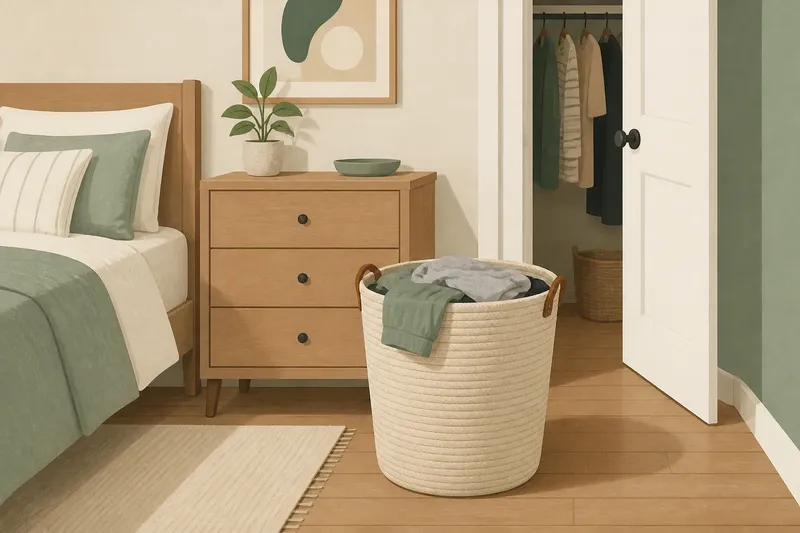
A laundry basket can make a bedroom feel orderly or turn a clear walkway into an obstacle course. Where to put a laundry basket depends less on the basket itself than on where clothes are changed, where people pass, and how laundry leaves the room. Treat its placement as a small piece of furniture planning, not a final storage decision.
The laundry basket became furniture by staying in view
Clothes baskets began as practical containers: a place to collect garments and carry them toward washing. But once a basket settled beside a bed, in a closet, or near a bathroom, it acquired a second job. It occupied visible floor space every day, whether or not laundry was being done.
That everyday presence changes how a room works. A basket has an opening people need to reach, a body that takes up floor area, and often a handle that catches on nearby objects. Its position can help a routine happen with almost no thought—or make someone carry a shirt across the room to use it.
Today’s choices range from flexible woven hampers to slim plastic bins, divided sorters, and lidded containers. Each has a different visual and physical footprint. A soft-sided basket can tuck beside a dresser; a rigid sorter needs enough clearance for its compartments; a lid may hide clothes but adds another motion whenever someone drops in a sock.
The useful question is not whether a basket looks like furniture. It is whether its location behaves like furniture: stable, easy to approach, and considerate of the routes people use.
Choose the spot by the clothes’ route
Start with the ordinary path, not an idealized cleaning routine. Where do people change? Where do damp towels land? Which doorway or drawer gets used most? A basket makes sense near the point where clothes come off, as long as that location does not interfere with another necessary movement.
- Beside a bedroom dresser: A natural fit when people change in the bedroom and the basket can sit outside the drawer-opening area.
- Inside a closet: A good choice when the closet has clear floor space and its door remains easy to open. Check that hanging clothes do not brush into the basket.
- Near a bathroom: Useful when towels and everyday clothes collect there, provided the basket stays out of the doorway and away from wet splash zones.
- In a shared hallway: Usually a poor fit if it narrows the route. Consider a nearby room instead of making a passage double as a laundry station.
- At the laundry area: Sensible when people carry clothes there directly, but inconvenient if dirty clothes otherwise pile up in bedrooms or bathrooms.
Think about the whole path from worn clothes to clean ones. A basket near the bedroom may save small trips during the week, while a second, smaller container near a bathroom may keep towels from collecting on the floor. More containers are not automatically better: each needs a clear purpose and a place that does not obstruct the room.
What placement fits your household?
Where should a laundry basket go in a small bedroom?
Choose a narrow, stable basket that fits beside a dresser or along a wall without blocking the bed-to-door route. If the only available spot prevents a drawer from opening, move the basket to a closet or nearby bathroom rather than forcing the room to work around it.
Should a laundry basket be kept in the bathroom?
It can suit a household where clothes and towels are removed there, but it should stay clear of the door swing and areas that get wet. If the bathroom is compact or shared, a basket just outside it may be easier for everyone to use.
Is a lidded hamper better than an open basket?
A lid can make a room look calmer when laundry is visible from the main seating or sleeping area. An open basket is easier to use quickly, so it may suit a busy changing spot better; choose based on the room’s appearance and how often people will need to lift the lid.
How many laundry baskets does a household need?
Begin with one container for the main collection point, then add another only if it solves a distinct problem, such as keeping towels separate from clothes. If several baskets create uncertainty about where items belong, simplify the system rather than adding labels and rules.
Let the room decide between open, hidden, and divided
An open basket makes dropping clothes effortless and keeps its contents easy to see. That visibility can be helpful when people forget laundry exists, but it also makes color, fabric, and fullness part of the room’s view. Choose one that looks composed enough to live in the open, or place it where the contents are not the first thing someone sees.
A lidded hamper softens the visual presence of laundry, especially in a bedroom used for resting. It works best when the lid is light and simple to lift. A heavy lid, tight opening, or awkward hinge can turn a quick habit into a small annoyance, and clothes may end up beside the hamper instead.
A divided sorter is useful when people already separate garments as they remove them, or when different household members need distinct sections. It is less helpful if its width claims the only clear part of a small room. Before choosing one, picture its full footprint and the space needed to reach every compartment.
Materials matter in practical ways. Woven baskets can feel at home in a bedroom but may have a broader shape than a slim plastic bin. Fabric hampers are light to move, while rigid containers hold their shape. Handles help when the basket travels, but they should not snag on closet doors or protrude into a narrow route. Follow product care directions, particularly for a removable liner.
Make the basket easy to approach and easy to move
A basket needs more than a place to sit. Leave enough room to drop in clothes without twisting around furniture, and keep it away from drawers, closet doors, and the route to the bed. If people need to shift it every time they open a cabinet, the location is asking for a different arrangement.
Consider the basket’s exit route too. A hamper that is easy to fill may be awkward to carry through a tight doorway or around a corner. A pair of smaller containers can be easier to move than one bulky sorter, but only if they do not multiply clutter. A basket with handles may help on a longer walk; a lightweight bin can be simpler for a short trip.
Say you share a narrow bedroom with a closet door that opens toward the wall beside the dresser. A broad basket placed there would interrupt the door and make the drawers harder to reach. A slim hamper tucked inside the closet, just beyond the door’s swing, could keep clothes near the changing spot while leaving the bedroom route clear.
It is not worth measuring every inch or buying a special organizer before trying the simplest placement. Move the empty basket to a candidate spot for a day and notice whether people can reach it, open nearby doors, and carry it away comfortably. That quick check reveals more than choosing a container from a product photo.
Make a placement change without creating a new chore
When a basket feels misplaced, change one thing at a time. Move it closer to where clothes are removed, or shift it away from a doorway, then see whether the room becomes easier to use. If the location is shared, tell household members where it has moved; a basket is only useful if everyone can find it.
Keep the arrangement forgiving. A room may serve different purposes across the day, and laundry does not need a complicated sorting system to stay manageable. For a busy home, the best laundry basket placement is the one that lets clothes land in a sensible spot, leaves ordinary paths open, and can be carried onward without rearranging the room.
Revisit the choice when furniture moves or a household routine changes. Where to put a laundry basket is a small decision with a daily effect: place it where the room’s traffic and the clothes’ route meet, and let the rest of the space remain usable.